Settings
Card Design
Dictionary Information
Macrons (ā, ē, ī, ō, ū)
Card Front
Dictionary Information
Macrons (ā, ē, ī, ō, ū)
Total Words Learned:
Comprising Chapters
10 Study Tips
I. Read the words outloud.
It's true that you will never need to speak to an ancient Roman (unless you learn how to time-travel, in which case please bring me along). However, don't underestimate the importance of pronunciation— it's crucial for understanding components of Latin, especially when you learn new endings to form plural nouns and verb tenses.
There's a reason we spend so much time chanting the words in class. Don't just glaze over the words and make a "blah blah" sound in your head. Remember, the letters in Latin follow consistent rules (unlike in English). Review pronunciation rules here.
II. Write the words down.
You don't necessarily need to make your own hand-written flashcards (it still would be a good idea!) but consider having someone else say the words or press the audio buttons while you write down both the Latin word and its English meaning.
III. Pay attention to parts of speech.
Terms are color-coded by parts of speech:
IV. Draw nouns.
Who said studying has to be boring? Draw pictures of the nouns, and label them in Latin, of course. I am always happy to see students' creativity at work."
V. Act out verbs.
If you need a break from writing, give kinesthetic learning a shot. Say a verb in Latin while acting it out.
VI. Pay extra attention to adverbs and conjunctions !
Students frequently miss these parts of speech on assessments because they are harder to visualize in comparison to nouns, adjectives, and verbs. Honestly, you might just need to chant and write them over and over until they stick.
VII. Beware of hindsight bias.
Often, students make the mistake of thinking that they know the English meanings of words when they really don't.
What happens is that students will flip over a card and recognize the correct answer, but they don't truly know the correct answer. Remember, vocabulary quizzes are NOT multiple choice. They require students to produce the correct answer in writing, not identify the correct answer from a set. So before you hastily flip over a card, make sure that you say or write your answer first. If your answer doesn't match the back of the card, you don't know it well enough.
VIII. Avoid meaningless memorization shortcuts.
Remembering that the Latin word for "to live" (habitō, habitāre) starts with the letter "h" might help you on a quiz in the short term, but what about when you learn habeō, habēre? Making sure you thoroughly know a word will pay off in the long run. This is one reason saying the word outloud is helpful. Account for every syllable and for every letter.
IX. Learn derivatives.
Derivatives are English words that come from Latin words. As it turns out, Latin isn't so dead after all!
Example: An uninhabitable place is where nothing can live. (habitō, habitāre = to live)
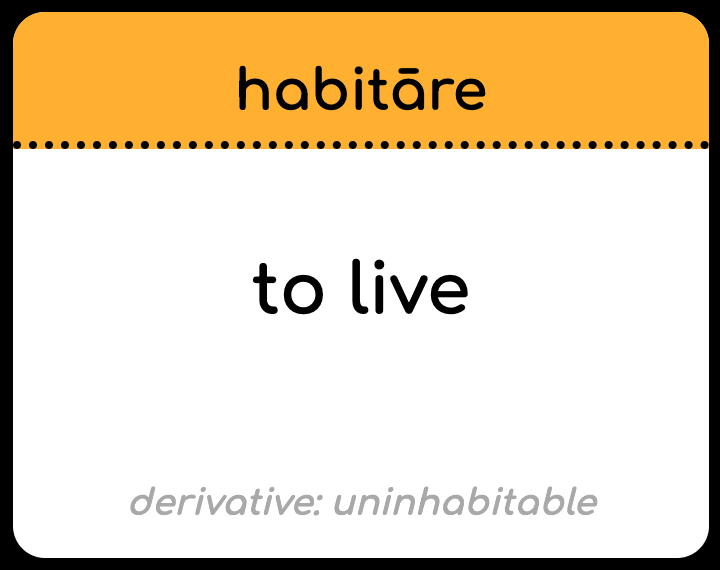
The SPA Latin teachers have provided some English derivatives in small gray print on the back side of the cards. You can earn extra points on quizzes by providing these (with correct spelling).
X. Study English to Latin.
You typically will only have to translate from Latin to English. However, if you study English to Latin, this will help ensure that you know the words really well. This is a more difficult skill that takes longer to achieve, even for Latin teachers.
It's true that you will never need to speak to an ancient Roman (unless you learn how to time-travel, in which case please bring me along). However, don't underestimate the importance of pronunciation— it's crucial for understanding components of Latin, especially when you learn new endings to form plural nouns and verb tenses.
There's a reason we spend so much time chanting the words in class. Don't just glaze over the words and make a "blah blah" sound in your head. Remember, the letters in Latin follow consistent rules (unlike in English). Review pronunciation rules here.
II. Write the words down.
You don't necessarily need to make your own hand-written flashcards (it still would be a good idea!) but consider having someone else say the words or press the audio buttons while you write down both the Latin word and its English meaning.
III. Pay attention to parts of speech.
Terms are color-coded by parts of speech:
- Verbs
- Nouns & Pronouns
- Prepositions
- Adjectives
- Adverbs
- Conjunctions
- Interjections
IV. Draw nouns.
Who said studying has to be boring? Draw pictures of the nouns, and label them in Latin, of course. I am always happy to see students' creativity at work."
V. Act out verbs.
If you need a break from writing, give kinesthetic learning a shot. Say a verb in Latin while acting it out.
VI. Pay extra attention to adverbs and conjunctions !
Students frequently miss these parts of speech on assessments because they are harder to visualize in comparison to nouns, adjectives, and verbs. Honestly, you might just need to chant and write them over and over until they stick.
VII. Beware of hindsight bias.
Often, students make the mistake of thinking that they know the English meanings of words when they really don't.
What happens is that students will flip over a card and recognize the correct answer, but they don't truly know the correct answer. Remember, vocabulary quizzes are NOT multiple choice. They require students to produce the correct answer in writing, not identify the correct answer from a set. So before you hastily flip over a card, make sure that you say or write your answer first. If your answer doesn't match the back of the card, you don't know it well enough.
VIII. Avoid meaningless memorization shortcuts.
Remembering that the Latin word for "to live" (habitō, habitāre) starts with the letter "h" might help you on a quiz in the short term, but what about when you learn habeō, habēre? Making sure you thoroughly know a word will pay off in the long run. This is one reason saying the word outloud is helpful. Account for every syllable and for every letter.
IX. Learn derivatives.
Derivatives are English words that come from Latin words. As it turns out, Latin isn't so dead after all!
Example: An uninhabitable place is where nothing can live. (habitō, habitāre = to live)
The SPA Latin teachers have provided some English derivatives in small gray print on the back side of the cards. You can earn extra points on quizzes by providing these (with correct spelling).
n.b. Sometimes, words change meanings over time, so derivatives might not always be helpful.
For example, the English word "trade" comes from the Latin "tradō, tradere" which originally meant "to give," rather than "to exchange."
All derivatives provided on this site are "safe."
X. Study English to Latin.
You typically will only have to translate from Latin to English. However, if you study English to Latin, this will help ensure that you know the words really well. This is a more difficult skill that takes longer to achieve, even for Latin teachers.
Print-Offs
The following are not official homework assignments, but additional (and encouraged!) study resources:
Frequently Asked Questions
The cards are color-coded by parts of speech:
- Verbs
- Nouns & Pronouns
- Prepositions
- Adjectives
- Adverbs
- Conjunctions
- Interjections
Yes! I'm glad you asked!
→Essential components of an English sentence (nouns, pronouns, and verbs) are warm colors to grab your attention. You need a noun or pronoun coupled with a verb to make a complete sentence.
→Non-essential modifiers are cool colors (adjectives and adverbs). You do not need adjectives and adverbs to make complete sentences, but they sure help make it more interesting.
→Like adjectives and adverbs, prepositions are non-essential and therefore highlighted in a cool color; you do not need a preposition to form a complete sentence. Prepositions are green because they show the relationship between nouns, and green is a color tangential to yellow.
→Conjunctions are brown because they are building blocks that link together words, phrases, and clauses. Think of a wood frame of a house.
→Interjections are white because they stand separate from the subject and predicate.
→Essential components of an English sentence (nouns, pronouns, and verbs) are warm colors to grab your attention. You need a noun or pronoun coupled with a verb to make a complete sentence.
- Example
-
puella ambulat .
The girl walks.
- Example
-
ambulat .
She walks.
- Example
-
ambulat .
She walks.
Tip: While I will never assign color-coding assignments, consider highlighting verbs orange on translation worksheets at the minimum.
→Non-essential modifiers are cool colors (adjectives and adverbs). You do not need adjectives and adverbs to make complete sentences, but they sure help make it more interesting.
- Example
-
puella pulchra ambulat lentē .
The pretty girl walks slowly.
→Like adjectives and adverbs, prepositions are non-essential and therefore highlighted in a cool color; you do not need a preposition to form a complete sentence. Prepositions are green because they show the relationship between nouns, and green is a color tangential to yellow.
- Example
-
puella sub arbore ambulat .
The girl walks under a tree.
→Conjunctions are brown because they are building blocks that link together words, phrases, and clauses. Think of a wood frame of a house.
- Example 1
-
puella et puer ambulant .
The girl and boy walk. - Example 2
-
puella ambulat sed puer currit .
The girl walks, but the boy runs.
Tip: When a conjunction joins two clauses, draw a vertical line before the conjunction to make sure you translate each clause with the right verb.
→Interjections are white because they stand separate from the subject and predicate.
- Example
-
Euge! puella ambulat .
Hooray! The girl walks.
Yes. All flashcard formatting settings can be found by clicking the gear icon in the top right corner of the page.
Yes.
Only for those with the sparkle icon. Still, knowing multiple synonyms is useful.
Romanus, Romana, Romanum (Roman); habitō, habitāre (to live); puella, puellae f. (girl) — there are multiple forms of a single word in Latin. These are best studied together as a unit. The extra word(s) other than the headword is called dictionary information. You will need to know it— not just for quizzes but to successfully understand Latin.
You will need to provide it on quizzes starting in chapter 4, at which point we will usually alternate between a meanings-only and a meanings + dictionary info quiz.
(Click the "Print-Offs" button at the top of the page to see an example of quiz formatting.)
On vocabulary quizzes, you will not have to provide any dictionary information that appears in parentheses.
For example, for "sub - under" you would not need to provide "takes ablative" on a vocabulary quiz. However, you'll still want to know that information down the road!


On vocabulary quizzes, you will not have to provide any dictionary information that appears in parentheses.
For example, for "sub - under" you would not need to provide "takes ablative" on a vocabulary quiz. However, you'll still want to know that information down the road!
Those "weird marks" are called macrons, and they show that a vowel is long. Macrons help us with pronunciation. The only macrons you are required to know are for second conjugation verbs.
If you click the gear icon in the top right corner of the page, there is an option for "Essential". Select this option to see the macrons you need to know at a bare minimum.
If you click the gear icon in the top right corner of the page, there is an option for "Essential". Select this option to see the macrons you need to know at a bare minimum.
No, audio files are static. I wouldn't want you to mispronounce words, and I'm not that advanced at coding anyway :)
Latin verbs are best learned in a set of four principal parts. In 6th grade, students learn the first two principal parts.
The first principal part is translated as "I [verb]" (always in the present tense).
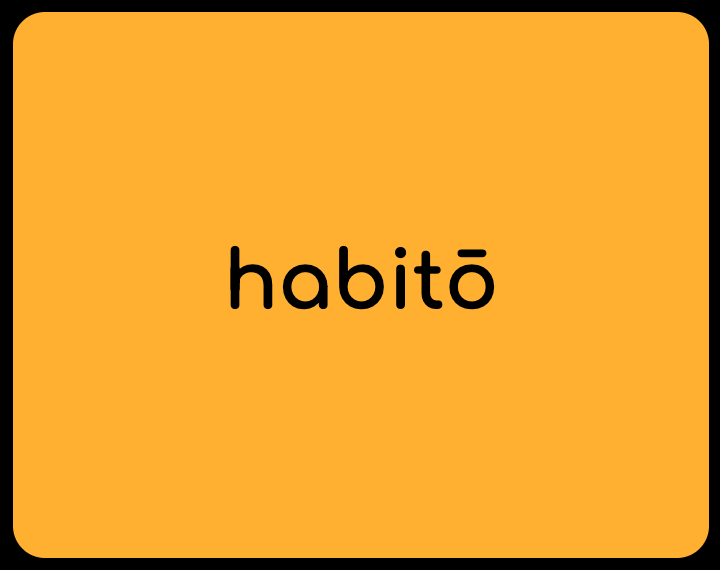
The second principal part, also called the infinitive, is translated as "to [verb]".
In class, we chant the first two principal parts followed by the definition of the second principal part. Example: "habitō, habitāre - to live". Students are encouraged to listen to and repeat full dictionary audios when studying at home.
The first principal part is translated as "I [verb]" (always in the present tense).
Example: habitō = "I live"
The second principal part, also called the infinitive, is translated as "to [verb]".
Example: habitāre = "to live"
In class, we chant the first two principal parts followed by the definition of the second principal part. Example: "habitō, habitāre - to live". Students are encouraged to listen to and repeat full dictionary audios when studying at home.
Yes. Trust us on this one.
The endings of nouns change based on how a noun functions in a sentence. We call this case.
The first noun form in the nominative case. The nominative case is used when a noun is a subject of the sentence.
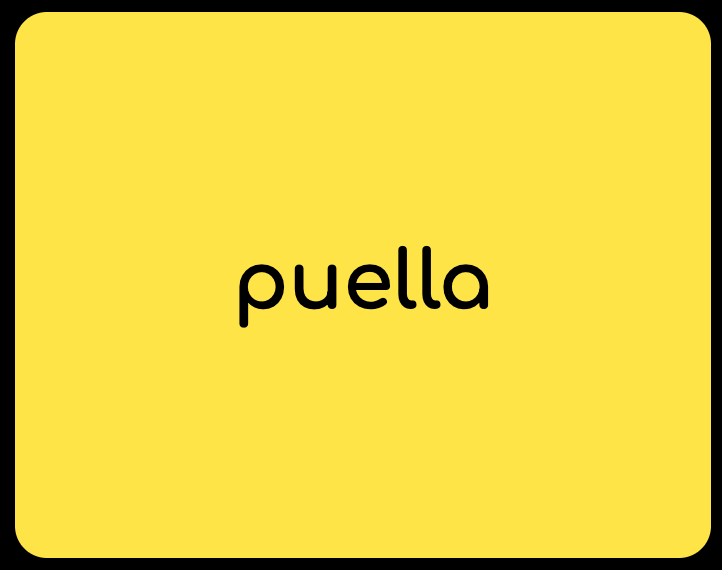
The second noun form is in the genitive case. The genitive case is used when a noun is a possessive (has ownership of something else).
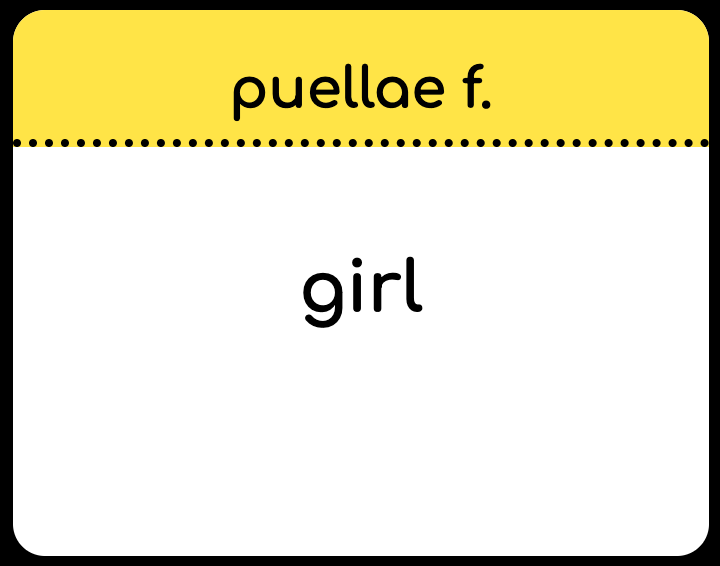
We actually don't see the genitive in translation until chapter 7. Still, the genitive serves other purposes and must be memorized accordingly.
The genitive singular matches the nominative plural for many nouns.
You will be able to tell if a noun is genitive singular or nominative plural based on the verb. We will practice this in class.
The first noun form in the nominative case. The nominative case is used when a noun is a subject of the sentence.
Example: puella est laeta.
The girl is happy.
The second noun form is in the genitive case. The genitive case is used when a noun is a possessive (has ownership of something else).
Example: villa puellae est.
It is the house of the girl.
OR
It is the girl's house.
We actually don't see the genitive in translation until chapter 7. Still, the genitive serves other purposes and must be memorized accordingly.
Warning!
The genitive singular matches the nominative plural for many nouns.
Example: pullae sunt laetae.
The girls are happy.
You will be able to tell if a noun is genitive singular or nominative plural based on the verb. We will practice this in class.
All nouns have gender, even nouns that are inanimate objects or intangible ideas. Nouns can be
- masculine (m.),
- feminine (f.), or
- neuter (n.)
You might have noticed that your teachers abbreviate dictionary information on their slides and handouts.
For example,
On quizzes, you need to write the expanded dictionary information (except for noun genders — m./f./n. are sufficient; for adjectives (blue cards), students may write -a, -um or -is, -e). After all, this is how we chant the words in class, and students will need to be in the habit of expanding these words when they conjugate verbs and decline nouns.
For example,
- habitō, -āre → habitō, habitāre
- puella, -ae f. → puella, puellae feminine
- vīcīnus, -a, -um → vicinus, vīcīna, vīcīnum
On quizzes, you need to write the expanded dictionary information (except for noun genders — m./f./n. are sufficient; for adjectives (blue cards), students may write -a, -um or -is, -e). After all, this is how we chant the words in class, and students will need to be in the habit of expanding these words when they conjugate verbs and decline nouns.
Some nouns and adjectives don't have abbreviated dictionary information. This is because there is what we call a "stem change."
Consider ager, agrī m. Notice that the genitive, agrī has lost the "e" after the "g". For this reason, you need to write out the full genitive on a quiz. This is why I (Ms. Alexander) encourage students to write out fully expanded dictionary information, regardless of whether or not a stem change occurs.
Consider ager, agrī m. Notice that the genitive, agrī has lost the "e" after the "g". For this reason, you need to write out the full genitive on a quiz. This is why I (Ms. Alexander) encourage students to write out fully expanded dictionary information, regardless of whether or not a stem change occurs.
Derivatives are English words that come from Latin words. As it turns out, Latin isn't so dead after all!
Example: An uninhabitable place is where nothing can live. (habitō, habitāre = to live)
The SPA Latin teachers have provided some English derivatives in small gray print on the back side of the cards. You can earn extra points on quizzes by providing these (with correct spelling).
Example: An uninhabitable place is where nothing can live. (habitō, habitāre = to live)
The SPA Latin teachers have provided some English derivatives in small gray print on the back side of the cards. You can earn extra points on quizzes by providing these (with correct spelling).
n.b. Sometimes, words change meanings over time, so derivatives might not always be helpful.
For example, the English word "trade" comes from the Latin "tradō, tradere" which originally meant "to give," rather than "to exchange."
All derivatives provided on this site are "safe."
No, you only need to provide one... but the more you know, the more connections you build!
Sort:
Stellae! (Stars!)
You are required to provide all English meanings for the quiz.